A fire damper can successfully pass a functional “drop test” and still have significant issues with its installation.
A drop test is an important part of fire damper inspection and maintenance. It demonstrates that the damper operates and that its blades can close when activated.
But operation is only part of the picture.
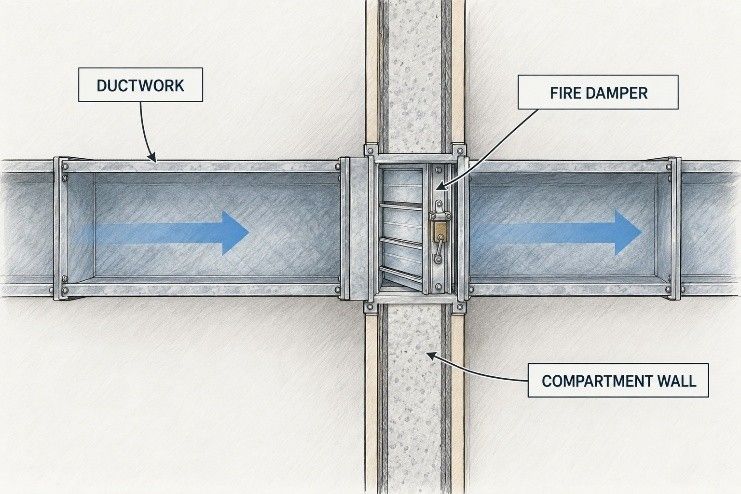
For a fire damper to perform as intended, the damper itself, its selection and the way it has been installed all matter. A damper that closes perfectly during an inspection may still have been installed outside the manufacturer’s tested installation detail or in a supporting construction for which it has no appropriate test evidence.
This distinction is important for building owners and managers because a report showing that every damper has “passed” may not necessarily mean that every installation has been adequately assessed.
What does a fire damper drop test actually prove?
For a mechanical fire damper, a functional test typically includes releasing the damper and confirming that the blades close fully and are free from obstructions before the damper is reset.
This provides valuable information about the operation and condition of the damper at the time of inspection.
What it cannot establish on its own is whether the complete installation is appropriate.
For example, a successful functional test does not by itself establish that:
- the correct type of damper has been selected for the application;
- the damper is suitable for the supporting construction in which it has been installed;
- the installation follows the manufacturer’s tested and approved installation method;
- the penetration and associated fire stopping are appropriate;
- the damper is correctly and independently supported where required;
- appropriate breakaway arrangements have been provided;
- the installation is consistent with the required fire compartmentation.
These are separate considerations, and they can be critical to the expected performance of the installation in a fire.
Why does the installation matter?
Fire dampers are tested as part of defined installation arrangements.
The supporting construction, damper type, orientation, penetration seal, fixing and support arrangements can all form part of the tested configuration.
This is why the manufacturer’s tested installation detail matters.
Installing a damper in a different type of construction simply because it physically fits does not automatically demonstrate that the resulting installation will provide the required fire performance.
If an installation falls outside the manufacturer’s tested detail, there needs to be appropriate evidence or approval supporting that alternative arrangement. Without it, successful movement of the blades during a drop test cannot demonstrate how the complete installation will perform under fire conditions.
The damper may work mechanically while the installation remains inadequately evidenced.
DW/145:2024 - looking beyond operation
BESA published a fully revised version of DW/145 in 2024, covering the design and selection, installation, inspection and maintenance of fire and smoke dampers.
The revised guidance reflects the importance of considering the damper as part of the complete installation. It highlights matters including manufacturers’ installation instructions, penetration seals, accessibility for inspection and maintenance, and appropriate selection and installation.
This is significant because fire damper inspection should not be reduced to a simple question:
Did it close?
Functional testing remains important, but the condition and installation of the damper can provide equally important information to the person responsible for the building.
Real example: it passed the drop test but not the inspection
During one of our inspections, we encountered a BSB fire damper which successfully completed its functional test.
The damper was accessible. Its fusible link was intact. The guide springs were intact, the blade channel was free from obstruction and, when drop tested, the damper fully closed.
On an operation-only assessment, there may have appeared to be little cause for concern.
However, our inspection also considered how the damper had actually been installed.
The damper was tested for installation within a particular fire-curtain arrangement. The installation we found incorporated an additional redundant curtain, resulting in a configuration that did not correspond with the manufacturer’s tested installation arrangement. Issues were also identified with the treatment of the damper support rods against the manufacturer’s guidance.
Our overall assessment was therefore non-compliant, despite the damper successfully closing during its functional test.
The drop test demonstrated that the damper could close. It did not demonstrate that the installation matched an appropriately tested arrangement.
What does “Pass” actually mean on a fire damper report?
A second example demonstrates why building owners should understand exactly what their inspection reports are assessing.
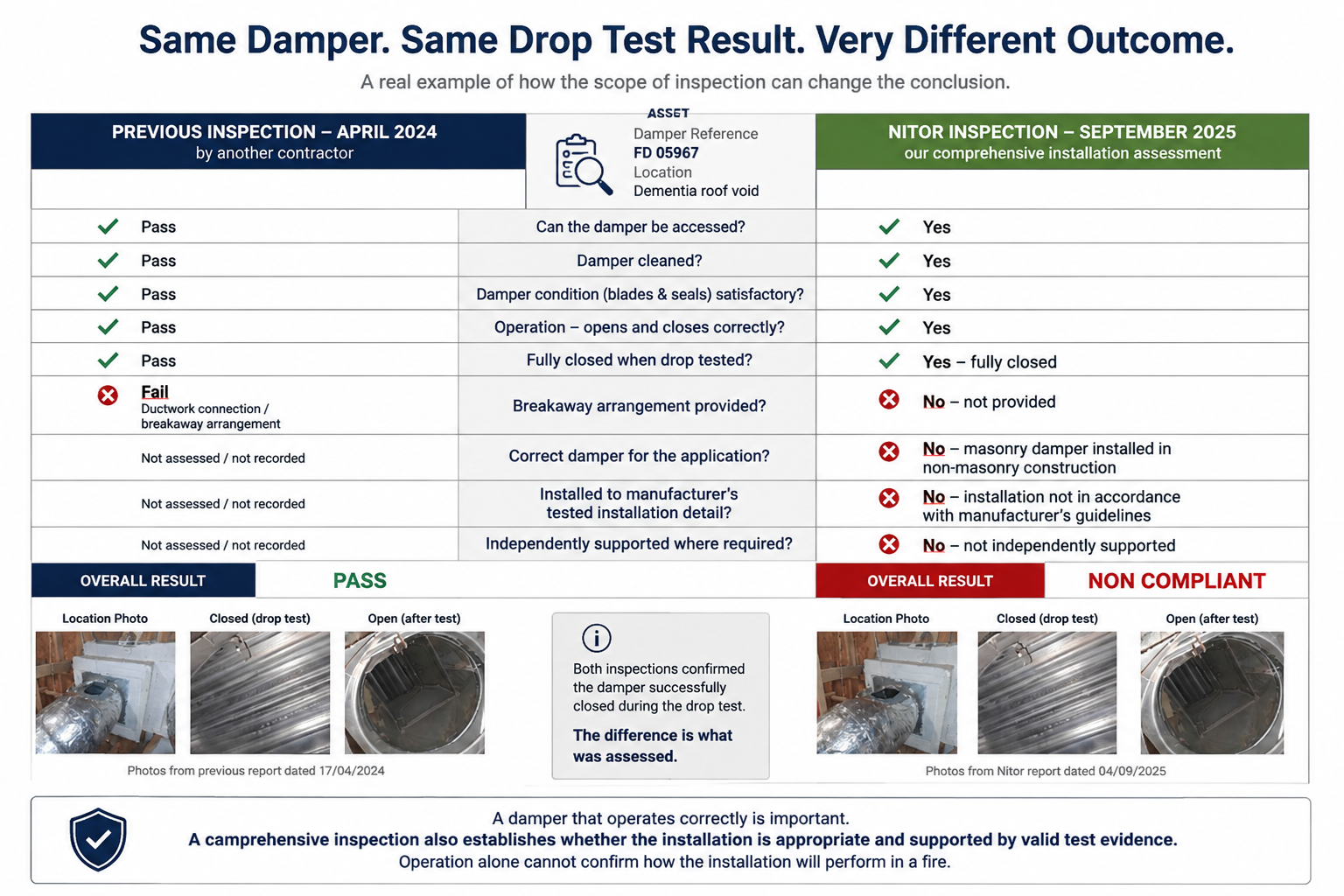
We inspected an existing mechanical fire damper which had previously received an overall Pass from another inspection.
The previous report recorded that the damper could be accessed, cleaned and operated correctly. It confirmed open and closed positions and recorded satisfactory blade and seal condition.
It also recorded a failure relating to the ductwork connection/breakaway arrangement, while nevertheless recording the overall inspection result as Pass.
When Nitor subsequently inspected the same asset, it again successfully completed its functional test. It fully closed when drop tested.
However, our assessment identified several issues with the wider installation.
Most significantly, the damper was intended and tested for a masonry application but had been installed within a different supporting construction. Appropriate test evidence or manufacturer approval for the arrangement as found could not be established.
We also identified issues including the absence of an appropriate breakaway arrangement and independent support.
Same damper. Same drop-test result. Very different outcome.
An anonymised comparison showing how the scope of inspection can change the overall conclusion.
Functional test
Successful
Overall installation assessment
Non-compliant
The damper operated. The difference was what the inspection established about the installation.
This is not simply about one contractor “passing” something that another contractor “failed”.
The more important question for a building owner is: What did each inspection actually assess before arriving at its conclusion?
If the scope principally establishes whether the damper operates, an overall “Pass” can potentially give a very different impression from an inspection that also considers whether the installation is appropriately evidenced.
What should a comprehensive fire damper inspection consider?
At Nitor Ventilation, we believe a meaningful inspection should provide the building owner or responsible person with information about more than movement alone.
Depending upon the damper and installation, our assessment considers areas including:
- damper identification, location and accessibility;
- damper type and suitability for the application;
- functional operation and full blade closure;
- condition of the damper and its components;
- supporting construction and fire compartment;
- installation against the manufacturer’s tested and approved method;
- penetration and associated installation details;
- support and breakaway arrangements where applicable;
- clear photographic evidence of the asset and installation;
- identification and classification of defects;
- recommendations where further investigation or remedial work is required.
The objective is to create a clear and traceable record of what has actually been inspected, what was found and how the resulting assessment was reached.
What should building owners look for in their existing fire damper reports?
If you already have a current fire damper inspection report, it is worth looking beyond the number of assets marked Pass or Fail.
Ask what evidence sits behind those results.
- Does the report uniquely identify each damper?
- Does it confirm that the damper was functionally tested and record the result?
- Does it assess the installation, rather than only the mechanical operation of the damper?
- Does it consider whether the damper is appropriate for the supporting construction and whether the installation is consistent with the manufacturer’s tested detail?
- Are relevant support, penetration and breakaway arrangements considered?
- Do the photographs provide meaningful evidence of the installation rather than simply showing that a damper exists?
- Where a defect has been identified, does the report clearly explain the issue and what action is recommended?
- Is there enough information within the report for you to understand why an asset has been given its overall status?
A successful drop test is important - but it is not the whole inspection
Fire damper functional testing remains an essential part of inspection and maintenance. A damper that fails to close when required clearly needs attention.
But the opposite conclusion should not automatically follow.
A damper closing successfully does not, by itself, demonstrate that the complete installation is compliant or that it corresponds with an appropriately tested installation arrangement.
That requires consideration of the damper, its application, its installation and the evidence supporting it.
For building owners, estates teams and those responsible for fire safety, the question therefore should not simply be: “Did our fire dampers pass their drop tests?”
A better question is: “Do our fire damper inspections assess the complete installation, or only whether the damper operates?”
If your existing reports cannot answer that clearly, it may be worth looking more closely at what your current inspection programme actually covers.
Nitor Ventilation provides comprehensive fire damper testing and inspection, including assessment of functional operation, condition and installation.
Technical reference: BESA DW/145 (2024) - Guide to good practice for the installation of fire and smoke dampers.
Nitor Ventilation | Fire Damper Testing & Inspection